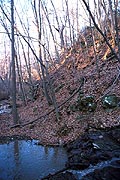
 Valley Stream
© 1999, W. Saslow
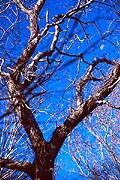 Moon Tree
© 1999, W. Saslow
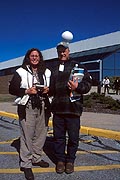 Dana & Matt
© 2000, W. Saslow
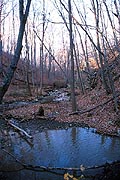 The Valley Floor
© 2000, W. Saslow
|
|
2003 Wildlife Management Goals and Objectives
The wildlife team will focus on three goals during the fourth year of this plan to increase biodiversity and environmental awareness on the REWHC Portsmouth campus.
- Increase the abundance and diversity of wildlife species.
- Increase environmental awareness at work and in the community.
- Protect our environment for future generations.
Goal 1: Increase Abundance and Diversity
We are managing our habitat to support sustainable wildlife populations. Planning activities include the definition and implementation of habitat controls and verification. Controls include modification of natural food supplies, nesting areas, and predation guards. Verifications include visual observation through Reporting. Example Relative Abundance And Relative Diversity Reports are shown for Birds and reflect the latest database entries. For a report representing a given range of dates, use the Report Selection Form to enter a time filter. In support of this goal, the following prescriptions are planned to meet stated objectives:
Objective:
- Re-establish the Eastern Bluebird on Aquidneck Island.
Prescriptions:
- Erect a "bluebird trail" of nestboxes around the campus,
- Aggressively monitor the boxes weekly to remove non-natives,
- Investigate efficacy of several bluebird-friendly nest box designs.
Progress:
- Nest Monitoring Program Established and progress may be viewed on-line.
- Predator guards added to nest box design and implemented for new boxes.
Objective:
- Provide habitat and cover for nesting birds.
Prescriptions:
- Reduce or eliminate mowing of meadow fields during nesting season.
Progress:
- Meadow Fields mowing reduced. See pictures of the meadow fields on-line.
- Invasive "bittersweet" vines thinned in selected areas to restor native undergrowth.
Objective:
- Increase butterfly and hummingbird populations.
Prescriptions:
- Establish and maintain Butterfly and Hummingbird gardens in front of building 1 (Nimitz), building 2 (Providence), and building 3 (Constitution).
- Introduce wildflower plantings in the Meadow Fields.
Progress:
- Butterfly and Hummingbird Garden planted in front of building 3 (Constutution).
- Wildflower garden planted in the meadow field. A picture of the wildflowers can be viewed on-line.
Goal 2: Increase Environmental Awareness
We are working with local organizations such as the Norman Bird Sanctuary and the USDA to put into effect a comprehensive process which promises to create long-lasting benefits for local wildlife. We are also setting up long-lasting relationships with local naturalists and historians to support our management efforts. In support of this goal, the following prescriptions are planned to meet stated objectives:
Objective:
- Get employees more involved with the environment:
Prescriptions:
- Provide Trailguides and Scheduled walks.
- Establish and maintain interpretive trails,
- Turn Earth Day into Earth Week and create family fun atmosphere in learning about the environment.
Progress:
- Trailguides established including an overall trail-guide and an interpretive trail guide both in pocket form and in ledger form.
- A "Welcome Guide" prepared,
- Trailwalks scheduled and held for employees on Earth Day, during the company picnic, and periodically through the year. Themes currently include the emerging forest, stone walls, site history, and birds.
Objective:
- Get the community more involved with the environment:
Prescriptions:
- Invite school groups for guided walks,
- Host Norman Bird Sanctuary birdwalks at our facility,
- Invite scout groups for guided walks,
- Have scouts build nesting boxes,
Progress:
- Boy Scouts built nesting boxes .
- Girl Scouts planted a tree .
- Norman Bird Sanctuary led birdwalks.
- Multiple Brownie groups hosted on trailwalks.
- Brownies Planted a Wildflower Garden.
Objective:
- Create lasting bonds with local organizations:
Prescriptions:
- Involve local organizations in surveys,
- Involve local organizations in earth day celebrations,
- Consult with local organizations on a regular basis.
Progress:
- Norman Bird Sanctuary helped us survey.
- Matt Largess helped us plant trees,
- Dana Filipini helped us plant a memorial garden and butterfly garden.
- Interpretive trailmaking discussion and trailwalk with Norman Bird Sanctuary Education Director and Director of Ballard Park Association
- Several trailbuilding discussions with the Aquidneck Island Land Trust, a local environmental organization, to discuss techniques in building their new "greenway" trail.
- Developed "Create-a-Bird" activity booklet, available for download here, and provided 200 copies to the Norman Bird Sanctuary for use in in-house and classroom bird adaptation piloting program. The create-a-bird activity was also featured during earth day as an environmental craft.
Goal 3: Protect our Environment For the Future
Objective:
Prescriptions:
- Survey species in the valley.
- Create photodocumentation,
- Involve local organizations and experts such as the Aquidneck Island Land Trust and Tree Steward Matt Largess,
- Meet with corporate management to discuss permanent protection.
Developing a Wildlife Habitat Management Plan
- Download a sample Wildlife Habitat Management Plan sample here (186kB).
- Download our Wildlife Habitat Management Plan in progress here (457kB).
- Provide comments on the plan in progress for the above revision by navigating to the appropriate subject for the revision under "wildlife planning" here.
|
|
Portsmouth, RI Location
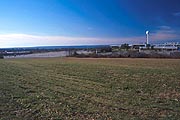
Roughcut Field
© 1999, W. Saslow
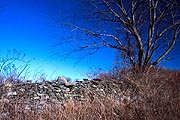
Great Wall
© 1999, W. Saslow
|
The Poplar Field
by William Cowper
The poplars are felled, farewell to the shade
And the whispering sound of the cool colonnade:
The winds play no longer and sing in the leaves,
Nor Ouse on his bosom their image receives.
Twelve years have elapsed since I first took a view
Of my favourite field, and the bank where they grew,
And now in the grass behold they are laid,
And the tree is my seat that once lent me a shade.
The blackbird has fled to another retreat
Where the hazels afford him a screen from the heat;
And the scene where his melody charmed me before
Resounds with his sweet-flowing ditty no more.
My fugitive years are all hasting away,
And I must ere long lie as lowly as they,
With a turf on my breast and a stone at my head,
Ere another such grove shall arise in its stead.
'Tis a sight to engage me, if anything can,
To muse on the perishing pleasures of man;
Short-lived as we are, our enjoyments, I see,
Have a still shorter date, and die sooner than we.
|
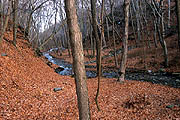
Golden Valley
© 2000, W. Saslow
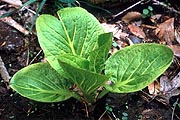
Skunk Cabbage
© 2000, W. Saslow
|
A Gleam of Sunshine
by Henry Wadsworth Longfellow
This is the place. Stand still, my steed,
Let me review the scene,
And summon from the shadowy Past
The forms that once have been.
The Past and Present here unite
Beneath Time's flowing tide,
Like footprints hidden by a brook,
But seen on either side.
Here runs the highway to the town;
There the green lane descends,
Through which I walked to church with thee,
O gentlest of my friends!
The shadow of the linden-trees
Lay moving on the grass;
Between them and the moving boughs,
A shadow, thou didst pass.
Thy dress was like the lilies,
And thy heart as pure as they:
One of God's holy messengers
Did walk with me that day.
I saw the branches of the trees
Bend down thy touch to meet,
The clover-blossoms in the grass
Rise up to kiss thy feet,
"Sleep, sleep to-day, tormenting cares,
Of earth and folly born!"
Solemnly sang the village choir
On that sweet Sabbath morn.
Through the closed blinds the golden sun
Poured in a dusty beam,
Like the celestial ladder seen
By Jacob in his dream.
And ever and anon, the wind,
Sweet-scented with the hay,
Turned o'er the hymn-book's fluttering leaves
That on the window lay.
Long was the good man's sermon,
Yet it seemed not so to me;
For he spake of Ruth the beautiful,
And still I thought of thee.
Long was the prayer he uttered,
Yet it seemed not so to me;
For in my heart I prayed with him,
And still I thought of thee.
But now, alas! the place seems changed;
Thou art no longer here:
Part of the sunshine of the scene
With thee did disappear.
Though thoughts, deep-rooted in my heart,
Like pine-trees dark and high,
Subdue the light of noon, and breathe
A low and ceaseless sigh;
This memory brightens o'er the past,
As when the sun, concealed
Behind some cloud that near us hangs
Shines on a distant field
|
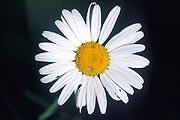
Ox-Eye Daisy
© 2000, W. Saslow
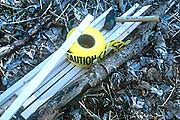
Staking The Town Farm
© 2002, W. Saslow
|